Hay and Mulch
We produce lucerne hay, lablab hay, barley hay, rhodes grass & cereal straw hay. These are supplied in small square & large square (3x3x8) & round bales. The round bale size is usually 4' x 4',
but other sizes can be made to order i.e. 3' x 4'.
Lucerne Hay:
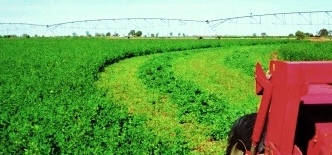
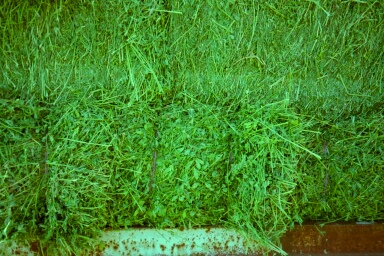
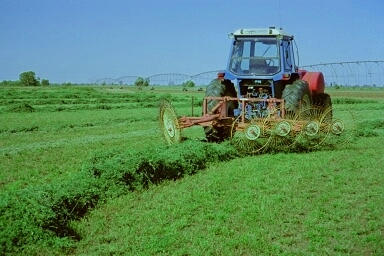
We grow the newer varieties of lucerne which are fine stemmed & produce lots of leaves making them quick to cure. All lucerne hay is grown under a centre pivot irrigator
producing an even uniform crop which makes for weed free & good solid bales. Mowing & carting of lucerne are done during the day, while raking & baling is done at night/
early morning utilizing the moisture then to maximize leaf retention & produce softer hay. In the Central Highlands' climate it takes only 3 to 4 days to make lucerne hay, thus
reducing bleaching & risk of weather damage. We cut lucerne hay all year round depending on irrigation water availability.
Rhodes Grass hay :
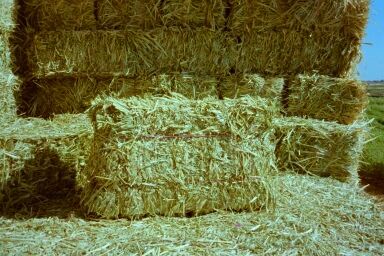 We grow Katambora variety of rhodes grass which has thinner stems & is suited to hay production. Rhodes grass hay is handled in much the same way as lucerne. We try to cut the grass when it is just coming out in head, this gives plenty of leaf & smaller stems, making a high quality product suitable to feed horses, weaners, bulls & in feedlots. Available in small squares & round bales. We have switched from growing forage sorghum to rhodes grass as feedback from customers has told us there is a lot less wastage occurring and it is a lot more suitable for horses.
Barley / Oaten hay:
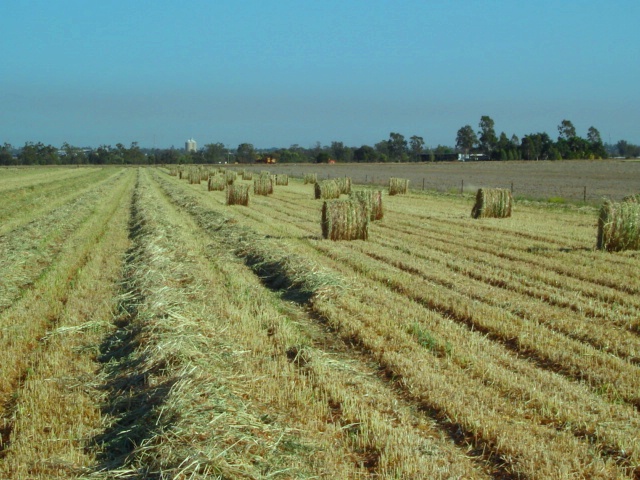
Available in both small square & round bales. It is made & handled with the same care as the lucerne, making a high quality product for chaffing, horse feed, weaning, bull preparation & feed lots.
Look for it around August/Sept.
Dolichus lablab:
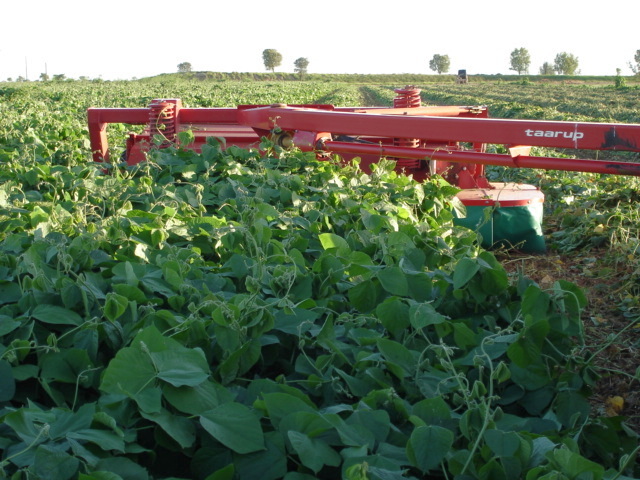 Lablab is a broadleafed tropical legume & is handled in a slightly different way. As it has very ropey & strong stems when cut, it requires longer curing time (often over a week). We bale lablab hay at two different times in the year. The first cut is usually around Jan/ Feb which is very good quality - plenty of leaf & smaller stems. The second cut is around July after harvesting the seed. The seed is also for sale. This cut has bigger stalks & lower leaf retention, but is still very palatable to adult cattle. Lablab hay is mainly round baled, but small squares can be made to order. Suitable for both horses and cattle. Some horse customers have found that their horses take readily to it & do very well on it.
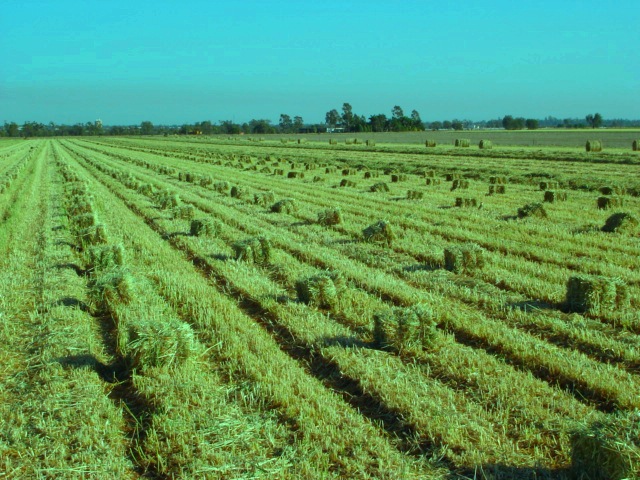 Cereal Straw Hay:
We often bale barley or wheat stubble/straw for uses including roughage for feedlot rations, garden mulch & mine site rehabilitation work. We bale a limited number of both small square & round bales to start with & go off demand after that. Normally we harvest the grain around late Sept / October, so would like orders in by then.
Mulch hay:
There is a degree of skill & good decision making in producing top quality hay, but luck with the weather plays a big part. Sometimes we get caught with unexpected rain on our cut hay in the paddock. If we get too much rain the quality is lost, so the hay is allowed to dry & is baled. It is set aside for use as mulch. This hay makes good garden mulch as leaf content is still quite high & is readily broken down to improve soil quality. Also there is usually very little weed seeds in it.